Category: Reflections

  • The Rise and Fall of Rome: Lessons for Modern Empires


    🌍 The Empire That Built the World

    The story of Rome is one of the most extraordinary journeys in human history — a small settlement in Italy that became the most powerful empire the world had ever seen.
    It built roads that still exist, wrote laws that inspired modern justice, and designed cities that remain models for urban life today.

    But like all great civilizations, Rome’s glory was not eternal. It fell not with a single battle, but through slow decay — weakened by corruption, overexpansion, and moral decline.


    ⚖️ Rome Before Islam

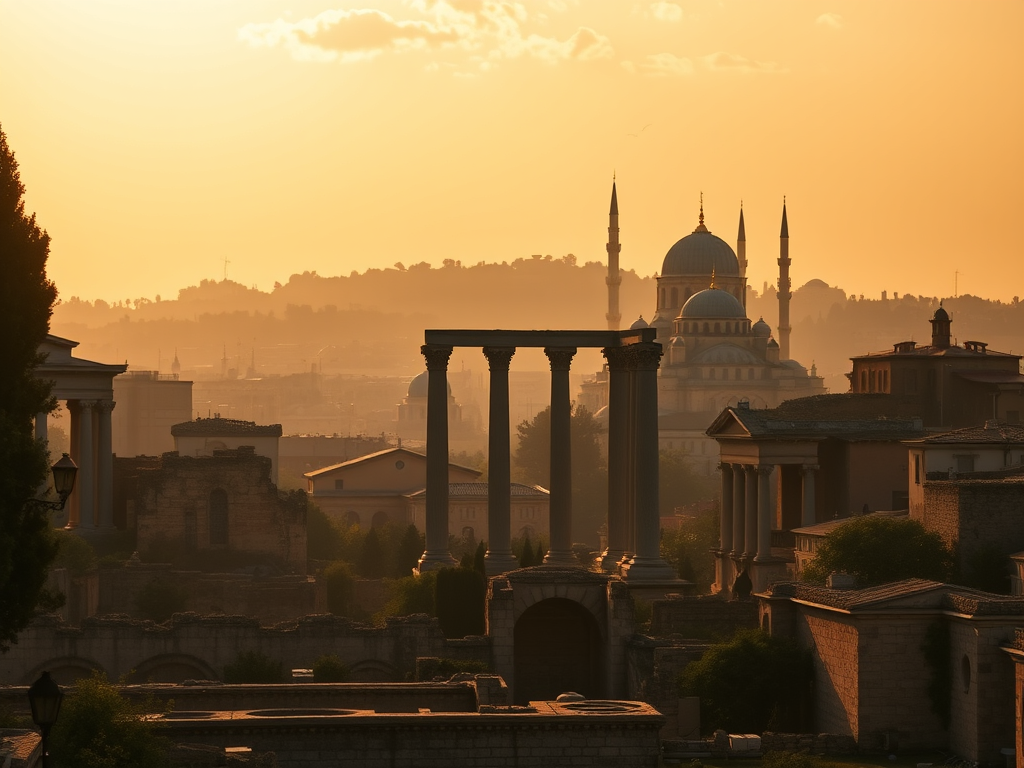
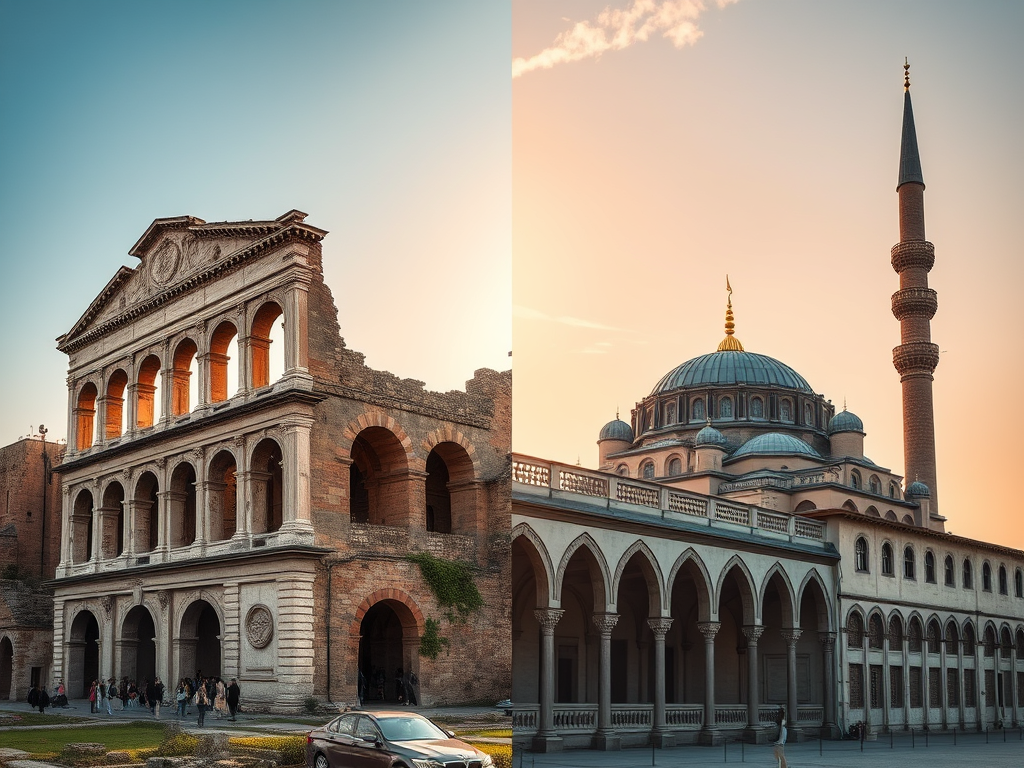
    By 476 AD, the Western Roman Empire had already collapsed. Yet its twin — the Eastern Roman Empire, also called the Byzantine Empire — lived on from its capital Constantinople (modern-day Istanbul).
    It continued Roman traditions for another thousand years, ruling lands that stretched from Greece to Egypt.

    So when Islam emerged in 610 AD, the Byzantines were still a global superpower.


    ⚔️ The Rise of Islam and the Clash with Rome

    When the Prophet Muhammad (peace be upon him) began spreading the message of Islam, two empires dominated the known world: the Romans (Byzantines) in the west, and the Persians in the east.

    After the Prophet’s passing, the early Muslim leaders — the Rashidun Caliphs — led with faith, unity, and justice. Within a few decades, their armies met the Romans in open battle.

    Major Turning Points:

    EventYearWhat Happened
    Battle of Yarmouk636 ADMuslims under Khalid ibn al-Walid (RA) defeated the Byzantines, gaining control over Syria and Palestine.
    Conquest of Egypt639–642 ADLed by Amr ibn al-As (RA), the Muslims took Egypt from Roman rule.
    North African Campaigns647–698 ADThe Muslims gradually took Libya, Tunisia, and the rest of North Africa.

    The Muslims didn’t destroy Rome — they succeeded it. They inherited the lands that the empire could no longer hold together.


    🏰 The Last Chapter — Fall of Constantinople

    The Eastern Roman (Byzantine) Empire survived for centuries longer, but it was finally brought to an end in 1453 AD.
    Sultan Mehmed II, known as Mehmed the Conqueror, led the Ottoman Muslims in capturing Constantinople after a 53-day siege.

    That moment ended over 2,200 years of Roman history — from the founding of Rome in 753 BC to the rise of Istanbul under Islam.


    💭 The Lesson of Two Civilizations

    The fall of Rome and the rise of Islam teach us a timeless truth:

    “Empires rise through discipline and justice — they fall through arrogance and moral decay.”

    Rome had everything the modern world has — advanced technology, comfort, and wealth — yet it lost its spiritual purpose.
    Islam, at its dawn, brought faith, equality, and unity — values that reshaped the world for centuries.


    ✨ Closing Reflection

    History doesn’t repeat itself — but it rhymes.
    The same forces that built and broke Rome — power, wealth, pride — still move our world today.
    Perhaps, like the Romans, we too must learn to balance progress with purpose.

  • My Digital Peace Pact: Choosing Peace Over Past

    Photo by Miray Bostancu0131 on Pexels.com

    There’s a quiet kind of pain that comes from opening an app and being pulled back into a world you’ve tried to move on from.

    You open WhatsApp and see statuses from people you once knew—some who hold beautiful memories, others who remind you of rivalry, envy, or a version of yourself you no longer want to revisit. You scroll through Facebook and see highlight reels of other people’s lives—career wins, travel, relationships, success.

    And somewhere in your heart, you feel… something heavy.

    You don’t want to compare. You don’t want to care. But your peace is disturbed anyway.


    🔁 What Social Media Was Supposed to Be

    Social media promised connection.
    But what I’ve felt, more often than not, is:

    • Disconnection from my present
    • Comparison with lives I don’t truly know
    • Regret over memories I can’t or don’t want to relive
    • A whisper of unworthiness

    I want to live my life, not keep watching someone else’s unfold like a never-ending slideshow.


    📿 What I Truly Want

    I want:

    • Silence from the past that no longer serves me
    • Freedom from subconscious competitions
    • A space where I can breathe, reflect, and move forward
    • Peace—not performance

    This is not bitterness. It’s clarity.
    This is not running away. It’s walking home to myself.


    📱 My Digital Peace Pact

    Here’s what I’m doing:

    1. Muting WhatsApp Statuses that don’t bring me peace
    2. Unfollowing people on Facebook who stir up unhealthy feelings
    3. Opening apps with intention, not out of habit
    4. Replacing noise with nourishment—Islamic reflections, writing, nature, and silence
    5. Noticing how I feel after using an app, and adjusting accordingly

    💭 My Life Is Not a Race

    We all bloom in different seasons.
    Some people may look “ahead,” but I’ve realized this: I am not behind. I’m just on my own path.

    And that path deserves presence.
    It deserves protection.
    It deserves peace.


    🌙 Final Words

    So this is my pact. My Digital Peace Pact.
    To mute the past when necessary.
    To stay present.
    And to live my life—not theirs.

  • When Help Isn’t Mutual: A Reflection on Expectations and Boundaries

    Photo by Pavel Danilyuk on Pexels.com

    Today wasn’t an easy day.

    From the moment I woke up, I wasn’t in the best mood. I had a small task that needed doing — nothing complicated, just a simple favor. I asked a colleague I spend most of my time with at university to collect a delivery from the office and leave it in our shared space. It was just from the ground floor to the first — no timing pressure, no complicated process.

    His response? “I’m busy.”
    So I asked another colleague. Same story.

    It stung.

    Photo by Andrea Piacquadio on Pexels.com

    I’ve often gone above and beyond for these same people — solving their issues, making time, going the extra mile. But today, when I asked for something small, they couldn’t reciprocate. I tried to justify it — maybe they were really busy. But the truth is, when someone accepts a responsibility and then simply doesn’t follow through, it’s more than inconvenience — it’s a breach of trust.

    One of them even said “I’ll do it,” but didn’t bother and just went home. That left me stuck. I ended up coming to the university — though I hadn’t planned to — just to ensure my own work didn’t suffer. And I was right: no one had done what they said they would.

    So what does that mean?

    It means I need to reassess where I put my energy.
    It means I need to protect my time and my mental peace.
    It means help should never be one-sided.

    Sometimes, silence says enough. I don’t need to lash out or confront them angrily. But I do need to set quiet boundaries — not out of spite, but out of self-respect.

    To everyone reading this:
    If someone consistently shows up for you, value them.
    And if you can’t help, it’s okay — but be honest about it.

    I’m learning not to expect everyone to match the way I show up for them. And maybe that’s the lesson today was meant to teach me.

  • Showing Up — Even When It Hurts

    Photo by Yelena from Pexels on Pexels.com

    Today’s therapy session didn’t go as I hoped.

    I was 15 minutes late — not out of carelessness, but because life has a way of throwing delays when you’re already carrying so much. It was supposed to be a one-hour talking therapy session, but the therapist told me we couldn’t do much now because of the reduced time.

    What hurt most wasn’t just the policy. It was the feeling of being shut down — of driving all the way there, battling my own thoughts and exhaustion, just to be told there wasn’t enough time to talk.

    And I felt vulnerable — not because of what we discussed, but because opening up itself felt like handing over my weaknesses. These things I carry as shame, I placed in the hands of someone who knows much about me… while I know almost nothing about him. That imbalance shook me.

    Therapy, I’m learning, is a one-way street. You give your truth. You give your pain. You hand over your fears. And sometimes, you wonder if that trust could be misused — not necessarily by malice, but simply by misunderstanding or indifference.

    As an overthinker, the whole experience drained me instead of offering peace. I walked away feeling heavier than when I arrived.

    But here’s what matters: I still showed up.
    Even when the odds were against me.
    Even when I was late.
    Even when fear and doubt whispered, “What’s the point?”

    Maybe the session wasn’t fruitful. Maybe there’s a policy to uphold. But I believe there’s something sacred about showing up — for yourself — especially when it’s hard.

    And that, I choose to hold on to today.

    This post is for anyone who’s ever felt dismissed, unheard, or rushed. For anyone who struggled just to get out of bed and go face the world — and did it anyway.

    You matter. Your effort matters. And your journey, however quiet or messy, is still worthy.

    Thanks for being here with me.

    – Wasif

  • Feeling Judged: A Quiet Struggle in Shared Spaces

    “There’s something I’ve carried quietly…”

    I do not like going to the other parks.
    Whenever I go, there is always someone who points out your little things — things you “shouldn’t” be doing.

    It makes me feel like I don’t have the freedom to simply exist.
    To just be.

    Someone is always observing, or judging.

    That’s exactly how I feel when I go to parks with an English majority.
    There’s a quiet sense of not belonging. A tension. A subtle, invisible judgment.

    Reflection

    I share this not to blame, but to breathe.

    To remind myself that I’m not alone in this experience — and maybe someone out there feels the same, silently, painfully.

    And perhaps through this small sharing, we begin to take back our space — with honesty, with calm, and without apology.

  • What Peace Means to Me Right Now

    What Peace Means to Me Right Now

    Photo by M Venter on Pexels.com

    Lately, I’ve been thinking about peace — not the kind you find in a silent room, but the kind that stays with you when everything is loud.

    There’s a difference between escape and peace. I used to think avoiding people or switching off my phone meant I was peaceful. But real peace, I’m slowly learning, is when you don’t need to fight everything inside yourself all the time.

    It’s when I sit with my son, not needing to teach him something — just being there.

    It’s when I stop comparing my life to others who seem more settled, more wealthy, more “together.”

    It’s even when I write words like these, unsure if anyone will read them — and that being okay.

    I haven’t always known peace. And I don’t always feel it now. But sometimes, it visits quietly — not with fireworks, but like a soft breath between thoughts.

    And maybe that’s enough for now.

    Still learning. Still listening.
    Still walking slowly, toward something more lasting.