Category: Reflections

  • When Life Feels Heavy, Keep Walking

    Photo by Fidan Nazim qizi on Pexels.com

    There is a kind of tiredness that does not come from one bad day.

    It comes from carrying responsibility for a long time.

    From the outside, life can still look normal. You go to work. You answer messages. You keep your commitments. You make plans. You smile when needed. But inwardly, you know that some seasons are heavier than others. Not dramatic. Not chaotic. Just heavy in a quiet, persistent way.

    I think many adults live through this kind of season without talking about it much.

    Sometimes we imagine that once we come close to an important milestone, life will suddenly feel lighter. But that is not always how it happens. In fact, the final stretch can sometimes feel the most demanding. You are tired, yet you must stay focused. You have already given years of effort, yet a little more is still required from you.

    That is where many meaningful journeys test a person most.

    Lately, I have been reflecting on what it means to keep moving when life feels divided between duty, ambition, and uncertainty. On one side, there is the need to remain dependable in everyday work. On another, there is the effort to complete a long academic journey. Alongside that, there are family responsibilities, financial realities, and the ongoing question of what the future will look like.

    This is not an unusual life. In fact, it is the life many responsible people live. But responsibility has a weight to it, especially when a person is trying to build something while also trying to protect what already matters.

    What I have come to appreciate is that not every honorable season feels exciting.

    Some seasons are built on endurance.

    There is dignity in continuing to show up when life is not glamorous. There is dignity in doing ordinary work well, even when you know it is not your final destination. There is dignity in staying reliable, in carrying your duties properly, and in not allowing inner tiredness to become outer carelessness.

    In the modern world, people often celebrate visibility, speed, and outcomes. But many of the most important parts of a person’s character are formed in quieter places: in patience, in discipline, and in the decision to keep going without needing constant recognition.

    Another thing life teaches, especially when a person has lived between countries, is that external change does not automatically settle internal questions. A new place may bring new opportunities, but it does not remove the deeper responsibilities of life. You still have to think about family, stability, future direction, and where your efforts truly belong.

    Sometimes people assume that living abroad must always feel like upward movement. But life is rarely that simple. A person may earn more, yet still carry the same burdens in a different form. A person may gain opportunity, yet still feel the pull of home, belonging, and long-term uncertainty. The surroundings change, but the deeper work of life remains: building, sacrificing, deciding, and enduring.

    I have learned not to rush these questions too aggressively.

    Not every chapter of life gives immediate clarity. Some chapters are not for conclusion; they are for preparation. They teach you how to remain balanced while important things are still unresolved. They teach you how to carry two truths at once: gratitude for what you have, and uncertainty about what comes next.

    That is not weakness. That is adulthood.

    I also think we do ourselves a disservice when we assume that low energy means a lack of character. Sometimes a person is simply tired because they have been carrying real things for a long time. A tired person is not a failed person. A quiet person is not a broken person. A person questioning the next step is not necessarily lost. Sometimes they are simply standing in a demanding stretch of life, trying to remain steady.

    And steadiness matters.

    In my view, one of the clearest signs of maturity is learning to do the next necessary thing without turning every difficulty into a crisis. Prepare what needs to be prepared. Finish what needs to be finished. Rest where you can. Speak carefully. Think honestly. Keep your standards. Let time reveal what it has not yet revealed.

    There is also something humbling about realizing that much of life is not lived in major breakthroughs. It is lived in continuation. In carrying responsibility properly. In honoring commitments. In resisting despair. In protecting your mind and your values while the road is still uncertain.

    Perhaps that is why some of the strongest people do not always look dramatic. They simply keep walking.

    They do not have every answer, but they keep walking. They do not always feel inspired, but they keep walking. They do not know exactly how every part of the future will unfold, but they continue with sincerity, patience, and self-respect.

    That kind of strength is easy to overlook, but it is real.

    If you are in a season where life feels quietly heavy, where you are fulfilling your duties but still waiting for greater clarity, do not underestimate the value of your persistence. Some of the most meaningful progress in life is not loud. It does not announce itself. It forms slowly, through repeated acts of responsibility and faith.

    Sometimes the right response to a difficult season is not to force certainty from it, but to walk through it with dignity.

    And often, that is enough.

  • Responsibility Changes the Meaning of Success

    Photo by Mikhail Nilov on Pexels.com

    When we are young, success often looks simple.

    We imagine it as achievement, recognition, or reaching certain milestones. Success seems like a destination that can be clearly identified and celebrated.

    But as life moves forward, responsibilities begin to appear.

    Family, work, commitments, and the well-being of others slowly become part of our daily lives. These responsibilities change how we understand success.

    Success is no longer only about personal accomplishment.

    It becomes connected to stability, reliability, and the ability to support the people who depend on us.

    Sometimes this kind of success is quiet. It may not attract attention or recognition. It happens in everyday decisions: showing up when needed, continuing to work through challenges, and staying committed even when progress feels slow.

    Responsibility has a way of reshaping our priorities.

    We begin to value consistency more than speed. We learn that perseverance is often more important than short-term victories.

    Over time, we realise that success is not only about what we achieve for ourselves. It is also about the strength we develop while carrying our responsibilities with patience and integrity.

    And in many ways, that quiet strength becomes one of the most meaningful achievements of all.

  • Learning to Move at Your Own Pace

    Photo by Rachel Claire on Pexels.com

    One of the easiest traps in modern life is comparison.

    We constantly see what others are doing. Someone finishes their studies earlier. Someone starts a career sooner. Someone seems to move faster through life.

    When we observe these things, it is natural to ask ourselves a difficult question:

    Am I falling behind?

    For many people on long academic or professional journeys, this question appears often. Years of study can feel like standing still while others move forward. Friends begin careers, build financial stability, and move into different stages of life.

    Meanwhile, the academic path often requires patience.

    But over time, I have begun to realise something important: life does not move on a single timeline.

    Every person moves according to their circumstances, responsibilities, and choices. Some journeys require more preparation. Some require more endurance. Some require deeper learning before the next step can appear.

    Moving at your own pace is not failure.

    It is simply the shape of your journey.

    Comparison can make us forget how much progress we have already made. The lessons learned, the discipline developed, and the resilience built over time are all invisible achievements.

    These qualities may not show themselves immediately, but they become incredibly valuable later in life.

    When we stop measuring our path against others, something interesting happens.

    The pressure begins to fade.

    And we can finally focus on the one thing that truly matters:

    Taking the next step forward.

  • The Quiet Strength of Long Journeys

    Photo by Jou00e3o Cabral on Pexels.com

    Some journeys in life move quickly. Others take longer than expected.

    In today’s world, we often see success through visible milestones: promotions, financial progress, recognition, or public achievements. When progress is slow or less visible, it can sometimes feel as though nothing meaningful is happening.

    But many of the most important journeys in life are quiet ones.

    A long academic path is a good example. Years of study, research, and persistence rarely produce immediate rewards. The effort happens behind the scenes: reading late at night, solving difficult problems, repeating experiments, and learning to think more deeply about the world.

    From the outside, it may appear slow.

    From the inside, however, something important is happening.

    Long journeys build qualities that short paths cannot always provide. Patience becomes stronger. Resilience develops. You learn how to continue even when the outcome is uncertain.

    Over time, you begin to understand that progress is not always measured in obvious ways.

    Sometimes progress means continuing when the road is difficult.
    Sometimes it means staying committed to responsibilities.
    Sometimes it means choosing patience instead of frustration.

    Life also teaches that responsibilities—family, work, and commitments—are not obstacles to our journey. In many ways, they give the journey meaning. They remind us that our efforts are not only for ourselves but also for the people who depend on us and walk alongside us.

    When we begin to see life from this perspective, the idea of success changes.

    Success is not always loud.

    Sometimes it is simply the ability to keep moving forward with integrity and patience.

    Sometimes it is the quiet determination to continue building a better future step by step.

    And often, the most meaningful achievements are the ones that grow slowly, shaped by time, effort, and faith.

    Long journeys may test us, but they also strengthen us in ways we only understand later.

    Perhaps the real reward of a long journey is not only reaching the destination, but becoming a stronger and wiser person along the way.

  • Buying a Property the Halal Way in the UK: A Reality Check

    Photo by Pavel Danilyuk on Pexels.com

    For many people, property ownership in the UK appears straightforward:
    find a house, take a mortgage, pay monthly, and eventually own it.

    But for anyone who takes faith seriously, that path raises questions.

    As awareness about riba (interest) grows, so does the discomfort with conventional mortgages. At the same time, remaining stuck in long-term renting or living month to month does not feel like a solution either. What many people seek is not luxury — but peace of mind and stability.

    This blog is a reflection on what actually exists, what does not, and what works in reality when trying to buy property in the UK in a halal and responsible way.


    The Common Assumption About Islamic Banks

    Islamic banks in the UK do offer Sharia-compliant home purchase plans. These are typically based on Diminishing Musharakah, a structure where:

    • The bank purchases the property
    • Ownership is shared
    • Rent is paid on the bank’s share
    • Ownership is gradually transferred

    In theory, this appears to solve the problem of interest entirely.

    However, there is an important reality that is often overlooked.


    The Practical Limitations

    Islamic banks operate under strict regulatory and risk frameworks. As a result, they usually require:

    • A large deposit (often 20–30%)
    • Stable and provable income
    • Properties above certain value thresholds
    • Clean and detailed documentation

    For buyers with modest savings, particularly those starting with amounts such as £20,000, London and nearby suburban properties are generally not viable under this model. This is not exclusion — it is simply how risk is managed.

    Islamic banks are halal, but they are not designed for low-capital entry.


    The Core Truth About Halal Property Ownership

    One lesson becomes clear very quickly:

    Halal property ownership is slower, but structurally stronger.

    Avoiding riba requires accepting trade-offs. In practice, this means choosing one or more of the following:

    • Waiting longer
    • Buying smaller
    • Partnering transparently
    • Using interest-free personal arrangements instead of banks

    There are no shortcuts without compromise.


    A Realistic Halal Path Forward

    For many families, the most workable halal approach looks like this:

    1. Start With Available Capital

    • Savings are clearly ring-fenced for property
    • Funds are held securely in mainstream UK banking institutions
    • No speculative use of the money

    2. Use Interest-Free Personal Support Where Necessary

    • Small, manageable amounts
    • Clear repayment terms
    • Written agreements
    • No profit expectations

    This method has strong precedent in Islamic financial ethics.

    3. Buy Modestly and Rationally

    • Prioritise ownership over location prestige
    • Focus on areas where cash buyers are realistic
    • Avoid emotional decisions

    Peace of mind is more valuable than a postcode.

    4. Upgrade Later, Not First

    • A small halal asset builds confidence
    • Capital is preserved
    • Future options remain open

    More structured Islamic finance becomes feasible later, once capital and stability improve.


    Why This Approach Matters

    This path:

    • Avoids riba entirely
    • Avoids lifelong debt pressure
    • Preserves autonomy
    • Aligns finances with faith

    It may not be fast.
    It may not look impressive.
    But it allows people to move forward without anxiety.

    And that matters.


    Final Thought

    Modern systems encourage speed:

    • Buy quickly
    • Borrow heavily
    • Upgrade constantly

    Faith encourages patience.

    If halal wealth grows more slowly, it often does so without destroying families, relationships, or mental peace.

    Sometimes, owning less — cleanly — is the wiser choice.

  • The “Gold-Standard” Degrees: Skills That Don’t Expire (Even When Trends Do)

    Photo by Ron Lach on Pexels.com

    Every few years, a new subject becomes “the future.” Everyone rushes into it. Courses pop up everywhere. You hear success stories on YouTube. And then—quietly—the job market changes, the hype cools down, and many people are left holding a degree that doesn’t carry the value they expected.

    This doesn’t mean learning new subjects is bad. Innovation is real. But if you’re choosing a direction after FSc, it’s smart to think like a long-term investor: What is the “base currency” of careers? What stays valuable even when trends come and go?

    Just like gold holds value across decades, there are fundamental degrees and skills that remain in demand because society cannot function without them.

    Why Some Degrees Never Vanish

    Photo by Pavel Danilyuk on Pexels.com

    A degree stays valuable when it is connected to at least one of these “evergreen” realities:

    1. Human needs don’t change (health, food, shelter, safety)
    2. Infrastructure must be built and maintained (power, roads, water, buildings)
    3. Businesses must stay compliant (accounts, tax, audit, regulation)
    4. Complex systems must run reliably (supply chains, IT systems, security)

    When a degree is rooted in these realities, it has staying power.

    The Most Evergreen Paths After FSc

    Below are the safest long-term fields—degrees that rarely go out of demand and often travel well internationally.

    1) Healthcare: The Ultimate “Base Currency”

    Healthcare is the strongest example of “evergreen” work. People will always get sick, need treatment, require rehabilitation, and depend on medicine.

    Good options after FSc include:

    • MBBS (prestige and long pathway)
    • Nursing (high demand globally, practical and employable)
    • DPT (Physiotherapy) (rehabilitation is growing everywhere)
    • Pharm-D (medicines and pharma industry)
    • Allied Health (lab technology, radiology, anaesthesia, OT, etc.)

    Why it lasts: It’s regulated, essential, and tied to real human need.

    2) Engineering: The Backbone of Modern Life

    Engineering looks boring to some people until you realize: everything around us—roads, buildings, factories, machines, electricity—exists because engineers make it work.

    Most evergreen engineering fields:

    • Civil/Structural (housing, bridges, infrastructure never stop)
    • Electrical/Power (energy systems, grids, renewables, industry)
    • Mechanical (manufacturing, HVAC, maintenance, machines)

    Why it lasts: Infrastructure requires constant building, upgrading, and maintenance.

    3) Computing Fundamentals (Not Just “Trends”)

    Technology changes fast, but core computing never goes away. The key is to choose a path built on fundamentals—not only one fashionable tool.

    Strong, stable directions include:

    • Software engineering foundations
    • Databases & systems
    • Networking
    • Cybersecurity
    • Data/analytics (with real statistics and problem-solving)

    Why it lasts: Every serious business depends on systems that must be built, secured, and maintained.

    4) Accounting and Compliance: Quiet, Powerful, Always Needed

    Accounting rarely gets hype—but it’s one of the most stable career paths in any economy.

    Solid paths include:

    • Bachelors in Accounting/Finance
    • ACCA / ICMA / CA pathways

    Why it lasts: Businesses can cut many roles—but they cannot ignore tax, audit, compliance, and finance control.

    5) Supply Chain & Operations: The Hidden Engine of Jobs

    If products are being bought, sold, imported, delivered, stocked, or manufactured, supply chains are running behind the scenes.

    Stable routes include:

    • Supply Chain & Logistics
    • Operations Management
    • Procurement and inventory planning

    Why it lasts: Goods must move in every economy—especially in the UK, Gulf, and big cities.

    The “Base Skills” That Make Any Degree Stronger

    Even the best degree becomes weak if the person lacks the core skills that employers actually pay for.

    These are the true “evergreen skills”:

    • Communication (writing, speaking, reporting)
    • Math/logic and basic statistics
    • Problem-solving and troubleshooting
    • Digital literacy (Excel/Sheets, documentation, basic data tools)
    • Professional discipline (punctuality, reliability, teamwork)
    • Safety and compliance mindset (especially in healthcare, labs, engineering, operations)

    If someone builds these skills, they become employable in almost any market.

    A Simple Filter to Avoid the “Noise”

    Before choosing any degree, ask this:

    Is this subject mostly about one trend or tool… or is it a foundation that will still matter in 15 years?

    If it’s only a tool-based path with no deep fundamentals, it can fade quickly.

    If it’s tied to:

    • health,
    • infrastructure,
    • compliance,
    • operations,
    • or core computing,

    it usually stays valuable.

    Final Thoughts: Choose a Foundation, Then Specialize

    The smartest strategy is:

    1. Pick an evergreen foundation (healthcare / engineering / accounting / core computing / operations)
    2. Then specialize later based on interest and market demand

    That way, even if the “market trend” changes, the person’s degree still has value.

    Because when the noise settles, the world still needs:
    doctors, nurses, engineers, accountants, and people who keep systems running.

    That’s the career version of gold.

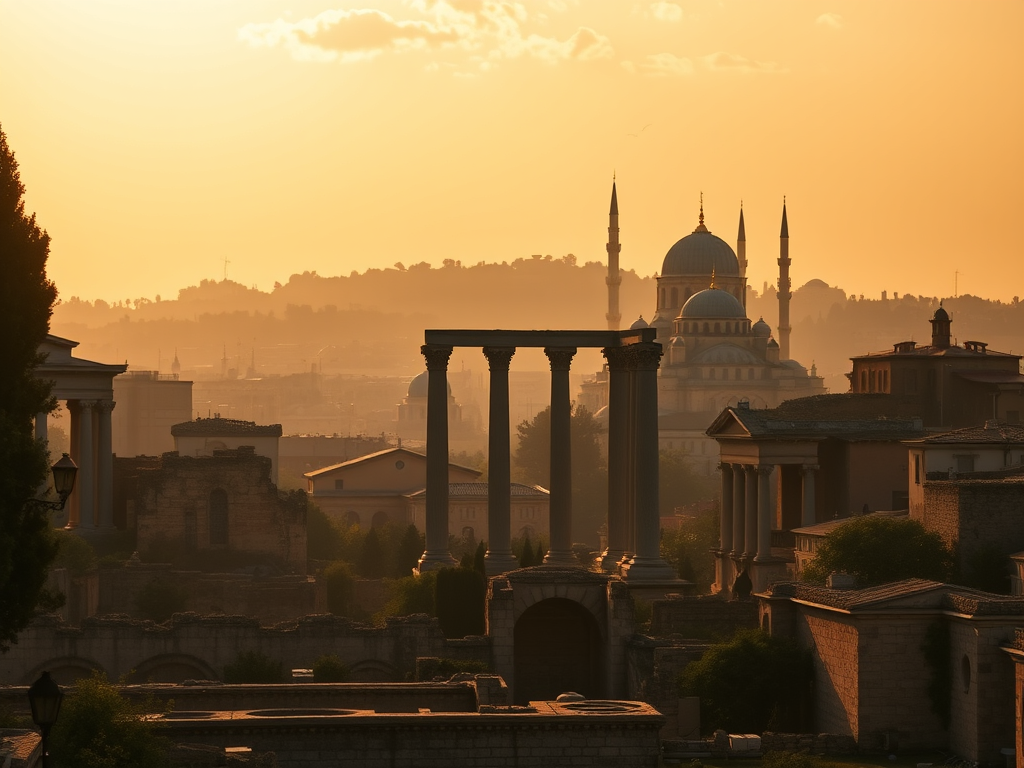
  • The Rise and Fall of Rome: Lessons for Modern Empires


    🌍 The Empire That Built the World

    The story of Rome is one of the most extraordinary journeys in human history — a small settlement in Italy that became the most powerful empire the world had ever seen.
    It built roads that still exist, wrote laws that inspired modern justice, and designed cities that remain models for urban life today.

    But like all great civilizations, Rome’s glory was not eternal. It fell not with a single battle, but through slow decay — weakened by corruption, overexpansion, and moral decline.


    ⚖️ Rome Before Islam

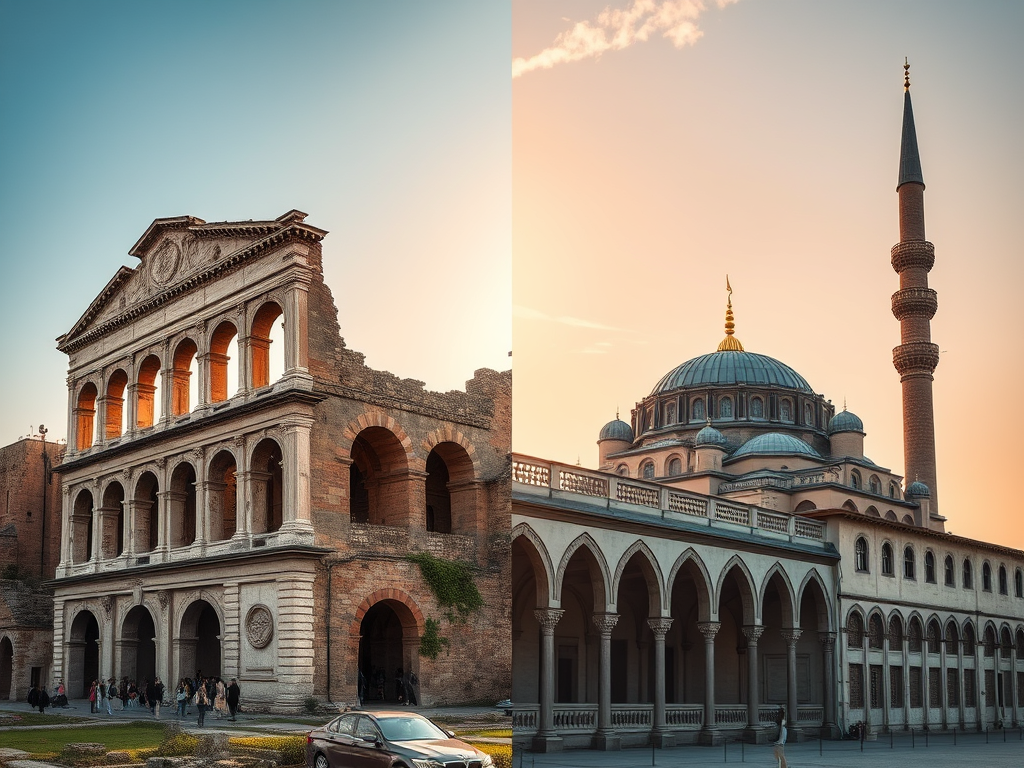
    By 476 AD, the Western Roman Empire had already collapsed. Yet its twin — the Eastern Roman Empire, also called the Byzantine Empire — lived on from its capital Constantinople (modern-day Istanbul).
    It continued Roman traditions for another thousand years, ruling lands that stretched from Greece to Egypt.

    So when Islam emerged in 610 AD, the Byzantines were still a global superpower.


    ⚔️ The Rise of Islam and the Clash with Rome

    When the Prophet Muhammad (peace be upon him) began spreading the message of Islam, two empires dominated the known world: the Romans (Byzantines) in the west, and the Persians in the east.

    After the Prophet’s passing, the early Muslim leaders — the Rashidun Caliphs — led with faith, unity, and justice. Within a few decades, their armies met the Romans in open battle.

    Major Turning Points:

    EventYearWhat Happened
    Battle of Yarmouk636 ADMuslims under Khalid ibn al-Walid (RA) defeated the Byzantines, gaining control over Syria and Palestine.
    Conquest of Egypt639–642 ADLed by Amr ibn al-As (RA), the Muslims took Egypt from Roman rule.
    North African Campaigns647–698 ADThe Muslims gradually took Libya, Tunisia, and the rest of North Africa.

    The Muslims didn’t destroy Rome — they succeeded it. They inherited the lands that the empire could no longer hold together.


    🏰 The Last Chapter — Fall of Constantinople

    The Eastern Roman (Byzantine) Empire survived for centuries longer, but it was finally brought to an end in 1453 AD.
    Sultan Mehmed II, known as Mehmed the Conqueror, led the Ottoman Muslims in capturing Constantinople after a 53-day siege.

    That moment ended over 2,200 years of Roman history — from the founding of Rome in 753 BC to the rise of Istanbul under Islam.


    💭 The Lesson of Two Civilizations

    The fall of Rome and the rise of Islam teach us a timeless truth:

    “Empires rise through discipline and justice — they fall through arrogance and moral decay.”

    Rome had everything the modern world has — advanced technology, comfort, and wealth — yet it lost its spiritual purpose.
    Islam, at its dawn, brought faith, equality, and unity — values that reshaped the world for centuries.


    ✨ Closing Reflection

    History doesn’t repeat itself — but it rhymes.
    The same forces that built and broke Rome — power, wealth, pride — still move our world today.
    Perhaps, like the Romans, we too must learn to balance progress with purpose.

  • My Digital Peace Pact: Choosing Peace Over Past

    Photo by Miray Bostancu0131 on Pexels.com

    There’s a quiet kind of pain that comes from opening an app and being pulled back into a world you’ve tried to move on from.

    You open WhatsApp and see statuses from people you once knew—some who hold beautiful memories, others who remind you of rivalry, envy, or a version of yourself you no longer want to revisit. You scroll through Facebook and see highlight reels of other people’s lives—career wins, travel, relationships, success.

    And somewhere in your heart, you feel… something heavy.

    You don’t want to compare. You don’t want to care. But your peace is disturbed anyway.


    🔁 What Social Media Was Supposed to Be

    Social media promised connection.
    But what I’ve felt, more often than not, is:

    • Disconnection from my present
    • Comparison with lives I don’t truly know
    • Regret over memories I can’t or don’t want to relive
    • A whisper of unworthiness

    I want to live my life, not keep watching someone else’s unfold like a never-ending slideshow.


    📿 What I Truly Want

    I want:

    • Silence from the past that no longer serves me
    • Freedom from subconscious competitions
    • A space where I can breathe, reflect, and move forward
    • Peace—not performance

    This is not bitterness. It’s clarity.
    This is not running away. It’s walking home to myself.


    📱 My Digital Peace Pact

    Here’s what I’m doing:

    1. Muting WhatsApp Statuses that don’t bring me peace
    2. Unfollowing people on Facebook who stir up unhealthy feelings
    3. Opening apps with intention, not out of habit
    4. Replacing noise with nourishment—Islamic reflections, writing, nature, and silence
    5. Noticing how I feel after using an app, and adjusting accordingly

    💭 My Life Is Not a Race

    We all bloom in different seasons.
    Some people may look “ahead,” but I’ve realized this: I am not behind. I’m just on my own path.

    And that path deserves presence.
    It deserves protection.
    It deserves peace.


    🌙 Final Words

    So this is my pact. My Digital Peace Pact.
    To mute the past when necessary.
    To stay present.
    And to live my life—not theirs.

  • When Help Isn’t Mutual: A Reflection on Expectations and Boundaries

    Photo by Pavel Danilyuk on Pexels.com

    Today wasn’t an easy day.

    From the moment I woke up, I wasn’t in the best mood. I had a small task that needed doing — nothing complicated, just a simple favor. I asked a colleague I spend most of my time with at university to collect a delivery from the office and leave it in our shared space. It was just from the ground floor to the first — no timing pressure, no complicated process.

    His response? “I’m busy.”
    So I asked another colleague. Same story.

    It stung.

    Photo by Andrea Piacquadio on Pexels.com

    I’ve often gone above and beyond for these same people — solving their issues, making time, going the extra mile. But today, when I asked for something small, they couldn’t reciprocate. I tried to justify it — maybe they were really busy. But the truth is, when someone accepts a responsibility and then simply doesn’t follow through, it’s more than inconvenience — it’s a breach of trust.

    One of them even said “I’ll do it,” but didn’t bother and just went home. That left me stuck. I ended up coming to the university — though I hadn’t planned to — just to ensure my own work didn’t suffer. And I was right: no one had done what they said they would.

    So what does that mean?

    It means I need to reassess where I put my energy.
    It means I need to protect my time and my mental peace.
    It means help should never be one-sided.

    Sometimes, silence says enough. I don’t need to lash out or confront them angrily. But I do need to set quiet boundaries — not out of spite, but out of self-respect.

    To everyone reading this:
    If someone consistently shows up for you, value them.
    And if you can’t help, it’s okay — but be honest about it.

    I’m learning not to expect everyone to match the way I show up for them. And maybe that’s the lesson today was meant to teach me.

  • Showing Up — Even When It Hurts

    Photo by Yelena from Pexels on Pexels.com

    Today’s therapy session didn’t go as I hoped.

    I was 15 minutes late — not out of carelessness, but because life has a way of throwing delays when you’re already carrying so much. It was supposed to be a one-hour talking therapy session, but the therapist told me we couldn’t do much now because of the reduced time.

    What hurt most wasn’t just the policy. It was the feeling of being shut down — of driving all the way there, battling my own thoughts and exhaustion, just to be told there wasn’t enough time to talk.

    And I felt vulnerable — not because of what we discussed, but because opening up itself felt like handing over my weaknesses. These things I carry as shame, I placed in the hands of someone who knows much about me… while I know almost nothing about him. That imbalance shook me.

    Therapy, I’m learning, is a one-way street. You give your truth. You give your pain. You hand over your fears. And sometimes, you wonder if that trust could be misused — not necessarily by malice, but simply by misunderstanding or indifference.

    As an overthinker, the whole experience drained me instead of offering peace. I walked away feeling heavier than when I arrived.

    But here’s what matters: I still showed up.
    Even when the odds were against me.
    Even when I was late.
    Even when fear and doubt whispered, “What’s the point?”

    Maybe the session wasn’t fruitful. Maybe there’s a policy to uphold. But I believe there’s something sacred about showing up — for yourself — especially when it’s hard.

    And that, I choose to hold on to today.

    This post is for anyone who’s ever felt dismissed, unheard, or rushed. For anyone who struggled just to get out of bed and go face the world — and did it anyway.

    You matter. Your effort matters. And your journey, however quiet or messy, is still worthy.

    Thanks for being here with me.

    – Wasif